5 Things to Know Before Buying a New Development in NYC in 2026
New developments can be beautiful.
Everything smells nice. The appliances look shiny, not greasy. The designs are clean. The amenities are akin to hotel living.
But over the years, I’ve realized there’s a widening gap between what real estate professionals know about new development in NYC and what buyers are shown.
Part of this may be due to TV and social media oversimplifying the home-buying process. The version that looks like this:
A buyer walks in.
Falls in love.
Pretends not to be in love.
Does some quick, tough negotiating.
Ka-ching. Picks up keys to a brand-new home.
If only real life were that neat!
As we head into a new year, I want to fill in those gaps for my dear readers and flag five important things to know before buying a new development in NYC (the things that don’t always come up at the sales gallery).
If You’re Buying New Development in NYC,
Here Are 5 Things You Must Know Before Signing Anything:
1. New Development Closing Costs Are Different (and usually higher, but read on for a secret)
First, a quick vocabulary lesson: In a new development, the sponsor is the seller.
Unlike resale condos, new development purchases in NYC often come with additional sponsor-related closing costs, including:
Sponsor’s NYS and NYC transfer taxes (between 1.85%-2.075%)
Sponsor attorney fees: Typically, around $3,500+
Resident Manager Unit (RMU): Calculated based on the buyer’s percentage of common interest in the building. Can be $10,000+
Working capital contributions: Typically, 2 months of common charges
Other special closing costs I’ve seen: Accessible parking space contribution (like RMU, calculated based upon the buyer’s percentage of common interest in the building
These costs don’t always show up clearly in the headline purchase price, but they matter a lot when you’re budgeting for a new development in NYC.
The secret they don’t always tell you:
Certain new developments can be much more negotiable on closing costs if you are willing to offer close to or at sticker price for the sale price! I have even gotten my clients extra concessions in addition to the 3.5%+ closing costs above, such as mansion taxes (a buyer closing cost for new developments and resales alike!), and a free storage unit worth $12,000-24,000!
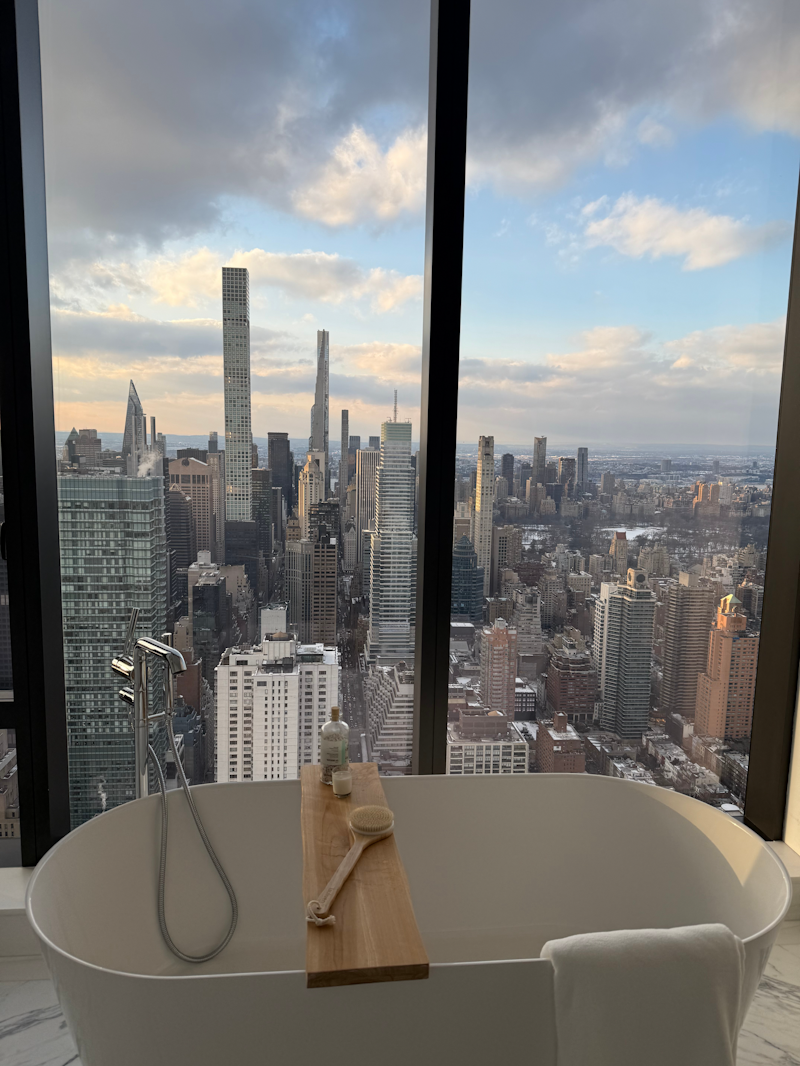
This bathtub view is one of many reasons to love new development!
2. Mortgage Lending Can Be Restricted Until the Building Is
“Declared Effective.”
For banks, a new development under construction is still an unknown.
The biggest milestone comes when at least 15% of units are in contract. At that point, the building’s offering plan is declared effective, and that's when your favorite banker is willing to lend you money to buy in this building.
Before that happens,
Some lenders won’t lend at all
Others will lend, but with stricter terms
This affects the rates, timelines, and your leverage.
This isn’t necessarily a problem, but it is something to plan around.
Many new developments will have a list of preferred lenders that have agreed to underwrite the building, potentially even before it is declared effective.
This certainly helps, but it may not be where your specific banking relationship is for the best rates (unless you are willing to move funds to a new bank).
3. New Development Closing Timelines Can Shift (and Rate Locks Can Expire)
New development closing dates are… aspirational.
Construction delays happen | Paperwork drags | Dates move
Unless the building is fully complete and has a Certificate of Occupancy, flexibility is essential.
If you’re locking in a mortgage rate, you need to understand:
How long does your rate lock last
Whether it can be extended
What happens if closing is delayed beyond the lock period
I’ve seen buyers caught off guard here, and back when interest rates tripled in 2022-2023, this was a big cause of stress.
Buying a new development in NYC requires planning not just for 'IF you close' but 'WHEN your close'.
4. You May Need to Put Up More Money Before Closing
In addition to your contract deposit, new development contracts often require additional deposits or funds at specific milestones before you close. If you have been saving for a down payment and are interested in buying a new development, you might be in for a surprise. It’s not the 10% down you expect for buying a condo.
These are outlined in the “procedure to close” factsheet that you can request from the sales office, and it will be in the contract too, but easy to miss if you’re not looking for them.
A typical NYC new development payment schedule might look like this:
15% deposit at contract signing
5% additional deposit, due either: Two months after contract signing, or 15 days after the building's offering plan is declared effective
80% balance at closing
Honestly, those terms aren’t that bad compared to some other markets. New development I’ve toured in Florida, Georgia and some I’ve learned about in Dubai all ask the buyer to fund the sponsor’s construction costs at 0% interest.
New development in NYC, on the other hand, have been launching sales pretty late in the construction cycle, often when the building has already been topped off, most windows are in, and you can go on hard hat tours. Sometimes you can even see model units in the actual buildings.
New dev projects I’ve seen in other markets often require 20% down before the construction site has even been demolished, 30% after building construction has broken ground, and another 20% after the building tops off. All in, you could have paid 70% before you get to the closing table to pick up your keys and move in. That closing could be 3+ years out from the moment you sign a new dev contract!
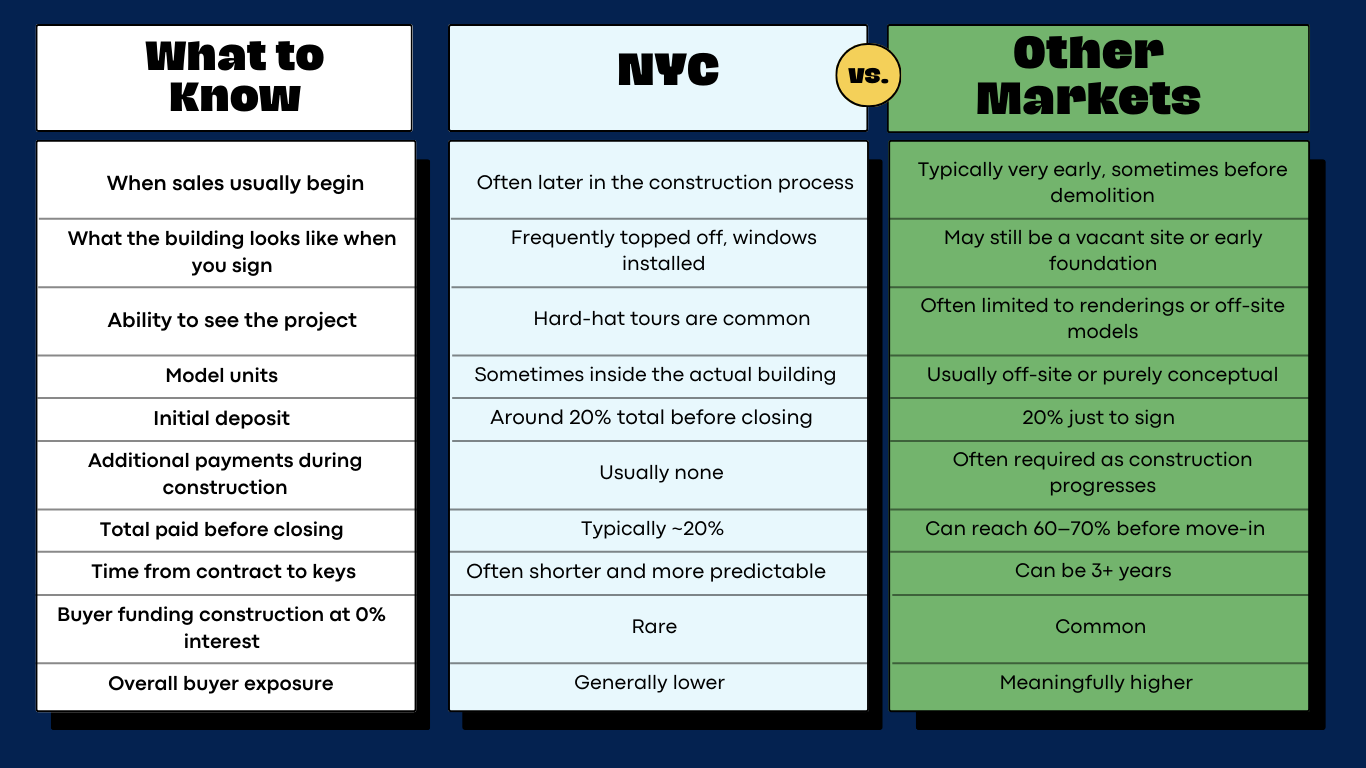
So, buying new development in NYC that require only 20% before closing and are mostly built before they start selling, suddenly seem quite buyer-friendly!
5. Walkthroughs and Blue-Tape Inspections Matter More Than You Think
This is your moment to be picky, and you should be. A new development walkthrough isn’t a formality. It’s your opportunity to flag.
Scratches in the floors
Chips in stone or marble
Doors that don’t close properly
Anything that isn’t up to standard
I do my inspections in a friendly yet firm way instead of making an enemy of the sponsor’s representative, whose help I need to fix these things, and I get everything done for my buyers.
No joke that one time I was doing a walkthrough for my new dev buyer with the construction manager who worked for the sponsor, and by the end of it they tried to hire me to work for them! I am known to be detail-oriented, and in the case of a new dev walkthrough, it really protects my buyers.
A proper walkthrough and blue-tape inspection means you get to move into that shiny, sparkling apartment you love and just paid $$$ for, as it’s much harder to get sponsors to fix little floor scratches after closing.
Final Thoughts on Buying New Development in NYC
New development isn’t something to fear.
But it is something to approach with eyes wide open.
When you understand how these deals actually work, you can enjoy their shiny beauty and sleep well at night.
If you’re considering a new development purchase this year and want help reading between the lines, I’m always happy to talk it through. No pressure. No rush. Book a free call with me below.
Here’s to fewer surprises and better decisions in 2026.